
 English
 German
 French
 Spanish
 Portuguese
 Italian
 Polish
 Turkish
 Romanian
 Greek
Greek
 Bulgarian
 Russian
 Arabic
 Hindi
Hindi
FOUNDRY WITH CNC MACHINING
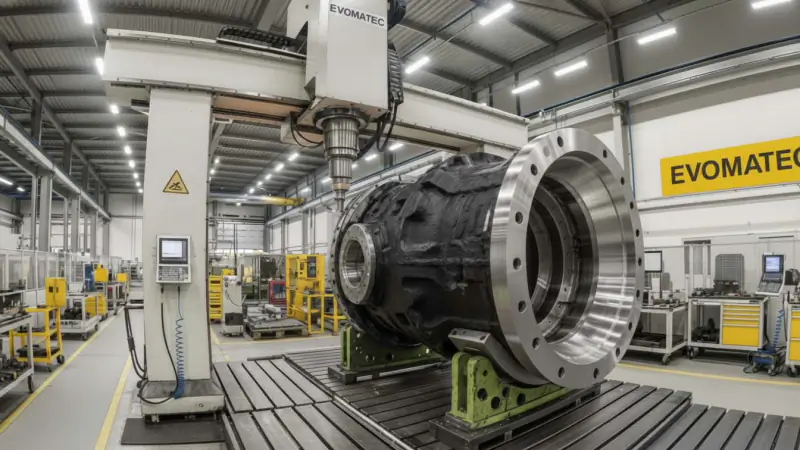
Foundry With CNC Machining: Cast Parts, Machining And Assembly-Ready Precision From A Single Source
A foundry with CNC machining is for many industrial customers the most efficient path to functionally reliable, assembly-ready components, because casting production and mechanical machining are planned and implemented within one continuous process chain. Instead of distributing raw castings across multiple stations, robust dimensional chains are created: the casting is designed for casting, manufactured with defined machining allowances, and then finalized through CNC milling, CNC turning, CNC drilling and CNC thread cutting so that fits, sealing surfaces and functional geometries are produced reproducibly.
Evomatec provides all services related to foundry projects: from selecting the suitable casting process and project planning to casting-oriented component design, coordination of casting and post-processing, as well as inspection planning, documentation and CNC finish machining. For customers, this means one point of contact, one coordinated process, clear responsibilities and traceable quality evidence. With many years of experience from a wide range of customer projects, Evomatec ensures that inspections are carried out with the utmost care and that quality as well as CE-compliant safety are consistently taken into account.
Why A Foundry With CNC Machining Is Today’s Industrial Standard
In modern applications, a raw casting is rarely sufficient. Housings require face-milled and sealing surfaces, bearing seats demand defined diameters and form tolerances, flanges need precise bolt-hole patterns, and interfaces must fit so that assembly is possible without rework. This is exactly where the value of an integrated process chain of casting and machining is created: machining cast parts by CNC is not just an operation, but a concept for functional reliability.
Fewer Interfaces, More Process Reliability
When casting and machining are organized separately, friction losses occur: unclear datum systems, unsuitable machining allowances, unexpected porosity zones in functional surfaces, or unnecessarily high machining volumes. An integrated foundry with mechanical machining reduces these risks because design, casting layout, fixturing strategy and measurement strategy are developed together.
Assembly Capability As The Target Metric
The key is not only that dimensions are met, but that the component functions reliably in the later system. For this, fit and tolerance must be clearly defined, manufactured and verified. A continuous process chain enables a consistent measurement concept including a measurement report and relevant documents such as a material certificate.
Terms And Fundamentals: What A Foundry With CNC Machining Must Truly Deliver
A real foundry with CNC machining does not start at the machine, but in the project phase. The most important building blocks are:
Casting-Oriented Design With Machining In Mind
Wall thicknesses, transitions, radii and functional areas must be designed so that casting quality in later machining zones is high. Sealing surfaces should not be located in shrinkage-critical hot spots, and critical fit zones require a layout that minimizes porosity and inclusions. This is where solidification simulation and riser technology are key tools to secure component quality in a targeted way.
Fixturing Strategy And Repeatability
Economical machining requires a stable clamping concept. Depending on the component family, a zero-point clamping system can significantly reduce setup times and increase repeatability. This is especially relevant when variants are produced in series or when prototypes need to be transferred quickly into a series logic.
Inspection And Documentation Logic
For many industries, inspectable processes are essential. This includes defined inspection features, a plausible inspection concept and, where required, non-destructive testing. What matters is that inspections are not only planned, but carried out safely and repeatably in daily operations. Evomatec relies on established routines here: with experience from many customer projects, inspections are organized so they take place with the utmost care and CE-compliant safety is consistently maintained in the inspection and handling environment.
Typical Casting Processes In A Foundry With CNC Machining
Which casting processes make sense depends on component size, geometry, quantity, material and functional requirements. Evomatec supports customers in selection and process planning for foundry projects so that casting quality and machinability reliably match.
Sand Casting: Flexible For Prototypes And Series
Sand casting is suitable for a wide range of component sizes and geometries. It is often economical in prototype production and can also be convincing in series production with stable process control. Typical parts include housings, structural parts and mechanical engineering components, which after fettling and, if necessary, after heat treatment are finish-machined on CNC equipment.
Permanent Mold Casting: Stability At Volumes
Permanent mold processes often deliver more consistent near-net dimensions and can reduce machining effort. Nevertheless, precise functional surfaces almost always require CNC machining, especially for sealing faces and fits.
Investment Casting: Precision And Surface, Then Functional Machining
Investment casting is attractive when contour fidelity and surface quality are the focus. Functional geometries are typically CNC-finished here as well, for example by reaming, facing, milling or thread cutting.
Materials And Machining: What Matters In CNC Machining Of Cast Parts
Material selection influences component properties, machinability, tool life and inspection strategy. A foundry with CNC machining must therefore evaluate material, casting process and machining together.
CNC Machining Of Aluminium Castings
CNC machining of aluminium castings is often economical because many aluminium alloys machine well. Critical are functional surfaces in areas of possible porosity. For housings, sealing surface machining is central, because flatness, roughness and form directly affect tightness.
CNC Machining Of Grey Iron Castings
CNC machining of grey iron castings is well established in mechanical engineering. Grey iron offers good damping and can often be machined very well. Nevertheless, local microstructure variations and surface zones from the casting process must be considered to achieve process-stable cutting data and reproducible surfaces.
CNC Machining Of Steel Castings
CNC machining of steel castings places higher demands on tool selection and cutting strategy. Heat treatment condition, alloy and component geometry determine machining effort, distortion tendencies and measurement strategy. For many steel casting components, documented inspections and evidence are particularly important.
From Simulation To Finish Machining: A Process Chain From A Single Source
Solidification Simulation And Riser Technology As Quality Protection
A robust casting layout uses solidification simulation to identify hot spots, feeding paths and potential shrinkage areas at an early stage. With clean riser technology, it is ensured that critical functional areas remain as free as possible from shrinkage defects. This reduces risk in sealing surfaces, bearing seats and fit zones and improves machinability.
Machining Allowances And Datum Systems
Machining allowances must be large enough to reliably clean the surface and establish dimensional chains, but small enough to limit machining volume. Datum systems and clamping surfaces are designed so that CNC programs run stably and measurements are unambiguous. This supports consistent quality in series production.
CNC Milling, CNC Turning, CNC Drilling And CNC Thread Cutting
In practice, rarely only one method is used. Many components combine milling and turning operations, complemented by hole patterns, reaming operations and threads. What matters is that toolpaths, clamping sequence and measurement sequence match, and that functional surfaces are produced in a process-stable way. Integrated process control reduces rework, complaints and assembly issues.
Quality Assurance, Inspection Planning And Inspections With CE-Compliant Safety
Measurement Report And Material Certificate As Standard Requirements
A measurement report documents compliance with critical dimensions and functional tolerances. A material certificate provides traceability regarding material condition and batch. In many industries, this documentation is a prerequisite for approvals and series start-ups.
Non-Destructive Testing And Functional Assurance
Non-destructive testing is used when internal defects, cracks or leakage risks must be excluded or assessed. The key is a function-oriented inspection plan that covers critical areas without generating unnecessary costs.
Inspections As Part Of Process Discipline
Inspections must be repeatable, safe and documented. In projects, Evomatec anchors the requirement that inspections are carried out with particular care and that CE-compliant safety is consistently maintained in inspection and handling routines. With many years of experience from numerous customer projects, inspections are implemented so that results are traceable and stand up to audits.
Industries And Applications: Where A Foundry With CNC Machining Makes Particular Sense
Mechanical Engineering And Plant Engineering
Housings, bearing blocks, structural parts and functional components benefit from casting-based shaping and CNC-accurate functionality. Fits and face surfaces determine assembly quality and service life.
Pumps, Valves And Fittings
Here, sealing surfaces, bolt-hole patterns and threads are decisive. The combination of casting quality and precise sealing surface machining is often the key to tightness and reliability.
Energy, Infrastructure And Heavy Industry
High loads, long service life and documented evidence are typical. An integrated process chain simplifies traceability, inspection planning and stable series supply.
Series Production And Prototype Production
Prototype production requires fast iterations and technical coordination. Series production requires stable processes, repeatability and clear inspection and measurement logic. A foundry with CNC machining can serve both requirements if the clamping concept, zero-point strategy and inspection plan are built consistently.
Costs And Economic Efficiency: What Really Determines The Price
Costs are not created by casting alone, but by the entire chain: model and tooling, mold and core system, melt, energy, post-processing, heat treatment, CNC time, tool wear, measurement effort, inspection effort and documentation. Often the overall view is decisive: an optimized casting with reduced machining can ultimately be more economical than an inexpensive raw casting with high rework.
Typical Cost Drivers
Unclear specifications, unfavorable geometries, excessive machining allowances, missing datum systems, unstable clamping concepts and oversized inspection scopes drive costs. Conversely, casting- and machining-oriented design, robust riser technology, a defined measurement strategy and a targeted inspection plan reduce the overall effort.
Future Trends: How Casting And CNC Are Evolving
The future lies in stronger data and process integration: simulation is used more consistently to reduce scrap. CNC processes become more automated, measurement systems are more tightly integrated into the flow, and traceability continues to gain importance. At the same time, requirements for safe handling, inspection environments and documented inspections will increase. In this environment, it is an advantage when inspections are organized with the utmost care and CE-compliant safety is consistently considered throughout the entire inspection and process environment, as Evomatec maps as a reliable partner for corresponding project requirements.
FAQ On Foundry With CNC Machining
Why Is CNC Machining Almost Always Necessary For Cast Parts
Because functional surfaces such as fits, sealing surfaces, bolt-hole patterns and threads require defined tolerances that can usually only be achieved reproducibly through CNC machining and verified by inspection
Which Documents Are Particularly Important For Industrial Customers
Often material verification such as a material certificate as well as a measurement report for critical dimensions are required. Depending on the application, non-destructive testing and corresponding inspection and traceability documentation are added
How Is Leak-Tightness Secured For Housings
Through casting design using simulation and riser technology, avoiding porosity-critical zones in sealing areas, precise sealing surface machining and an appropriate inspection plan that reliably evaluates the relevant functional surfaces
Request a free consultation: info@evomatec.de