
 English
 German
 French
 Spanish
 Portuguese
 Italian
 Polish
 Turkish
 Romanian
 Greek
Greek
 Bulgarian
 Russian
 Arabic
 Hindi
Hindi
SERVO-ELECTRIC PRESS BRAKE EVO II
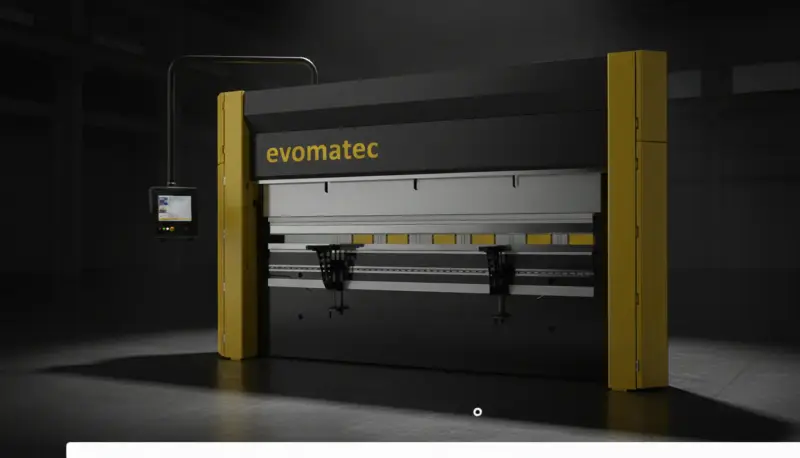
Servo-Electric Press Brake for Quiet, Clean, and Energy-Efficient Sheet Metal Bending EVO II
Overview: Modern Bending Technology Without Hydraulic Oil, With Servo Power
The EVO II is a modern press brake for precise sheet metal bending and efficient sheet metal processing in industry and workshops. As a servo-electric press brake, it operates without a classic hydraulic system and without hydraulic cylinders. This eliminates typical maintenance-intensive components such as oil, filters, and seals, reducing downtime and noticeably lowering operating costs. At the same time, the machine delivers very high repeat accuracy for professional metal bending, especially in series production and with changing parts.
Anyone looking for an electric press brake or a CNC press brake for sustainable manufacturing will find a solution here designed for energy efficiency, operator friendliness, and process reliability. The system is aligned with modern production requirements in which the combination of laser cutting and bending has become the standard: fast blanks, short setup times, reproducible angles, and stable results across many batches.
Quiet Production: Comfort and Quality in Daily Manufacturing
A key advantage of the EVO II is its very pleasant noise level. The downward movement is realized via a belt-based system, and the return stroke is supported by springs. This makes the machine particularly quiet and prevents disruptive noise exposure in production. For many companies, this is a real productivity factor: less stress, better communication, more stable quality, especially during long shifts and high utilization.
Low Maintenance Costs: No Hydraulic Oil, Fewer Wear Points
As a servo-electric press brake, the EVO II operates without a hydraulic system and without hydraulic cylinders. This significantly reduces the number of maintenance-relevant assemblies. No oil changes, no filter changes, no typical leakage topics. This not only lowers ongoing costs, but also increases machine availability. Especially for companies that strongly depend on delivery dates, this point is decisive when it comes to press brake service, press brake spare parts, and predictable maintenance.
Environmentally Friendly and Energy Efficient: Servo-Electric Drive as an Advantage in Cost Calculation
The EVO II stands for energy-efficient press brake technology. Thanks to the servo-electric drive, energy is used only when movement and forming actually take place. During phases without ram movement, the drives do not run continuously. As a result, energy savings compared to classic solutions are around 69 percent. In addition, a very high standby saving effect is possible: in standby, the system can save up to 98 percent energy. Anyone who considers the press brake price not only as a purchase, but as a life cycle, will quickly recognize the advantage in energy costs and operating costs.
Full CNC Equipment: 6 Axes as Standard for Precise Processes
In practice, not only press force determines quality, but above all controlled axis movement, repeat accuracy, and operating logic. The EVO II is designed as a CNC solution as standard and offers 6 axes: Y1, Y2, X, R, Z1, Z2. This makes it suitable for demanding parts, series production, and repeatable processes. Terms such as CNC backgauge, press brake angle measurement system, and press brake crowning stand in practice for exactly the goal: less rework, less scrap, fewer trial parts.
Depending on the configuration, proven controllers are available for the control system, for example ER99 or Delem 66T. This allows programs to be created, managed, and repeated safely, which is an important selection criterion especially with frequent item changes and when buying a CNC press brake.
Unlimited Full-Length Bending: Design for Maximum Part Freedom
A special design advantage of the EVO II is the concept of full-length bending without typical restrictions that occur with some classic designs. The system enables bending over the full working length between the side frames and is therefore highly flexible for long parts. For companies with a broad part spectrum, this is relevant because fewer compromises are required in part geometries and process planning becomes more stable.
Tooling and Interface: Stable Process With Professional Tool Technology
A press brake is only as good as the interaction between machine, tooling, and material. This is why the topic press brake tooling is so prominent in search queries. In practice, it is about reproducible results, short setup times, and safe tool clamping. The EVO II is designed for professional tooling applications, including common clamping interface solutions. Terms such as buy press brake tools, punch and die bending, and Wila tool clamping reflect the requirements of many users: standardization, fast availability, compatibility, and process reliability.
For stable results, workpiece handling and gauging technology are also important. The machine offers a precise backgauge system as well as front support so that sheets are guided safely. Especially with thinner sheets and long blanks, good support leads to significantly better bending results because the workpiece remains controllable and the operator has to correct less.
Typical Application Areas: Sheet Metal Production, Metal Fabrication, Laser Cutting and Bending
The EVO II is especially suitable for companies that run modern metal fabrication and sheet metal production and focus on efficiency. Typical applications include:
Enclosures, electrical cabinets, covers, and brackets
Mechanical engineering components, consoles, profiles, structural parts
Series production with changing items and short delivery times
Production lines in which laser cutting and bending runs as a standard process
Thanks to its energy efficiency, it is also interesting for companies that want to consistently optimize cost per part and pursue clear sustainability targets.
Purchase, Quotation, Delivery Time, Financing: Making the Investment Predictable
When companies search for buy a press brake or buy a bending machine, it is not only about technology. It is about investment security, service, delivery capability, and total costs. For a professional decision, the following points are typically relevant:
press brake quotation: configuration according to bending length, press force, axes, control, tool clamping interface, safety equipment
press brake delivery time: depending on version, options, control, tooling package, and scope of acceptance
press brake financing and press brake leasing: predictable monthly rates instead of a high one-time investment, often combined with service packages
new press brake versus used press brake: new for maximum efficiency and warranty, used as an entry option or with a stable part spectrum
buy used press brake and used CNC press brake: makes sense if condition, axis accuracy, control, safety standard, and spare parts supply are carefully verified
Search terms such as buy press brake also appear when comparing internationally. What always matters: process capability, ease of operation, and reliable support.
Service, Installation, Training, and Safety: Operational Reliability From the Start
For stable production, clear services are part of the package in addition to the machine. Typical topics in practice include:
press brake installation: positioning, leveling, electrical connection, commissioning, and functional testing
press brake training: operator training, programming, tool handling, process basics, error prevention
press brake CE and press brake safety standard: safety concept, light curtain, operator protection, documentation, compliant execution
Technical Data EVO II
| Technical Features | EVO II 1003 | EVO II 8026 | EVO II 6521 | EVO II 4016 |
|---|---|---|---|---|
| Bending length (A) | 3100 mm | 2600 mm | 2100 mm | 1600 mm |
| Press force | 100 t | 80 t | 65 t | 40 t |
| Standard V-die opening (v) | 50 mm | 50 mm | 50 mm | 50 mm |
| Sheet thickness (Rm = 42 kgf/mm²) (t) | 5 mm | 5 mm | 5 mm | 4.5 mm |
| Distance between uprights (B) | 3360 mm | 2860 mm | 2360 mm | 1860 mm |
| Y free-fall speed | 75 mm/s | 90 mm/s | 120 mm/s | 180 mm/s |
| Y bending speed | 10 mm/s | 10 mm/s | 10 mm/s | 10 mm/s |
| Y return speed | 75 mm/s | 90 mm/s | 120 mm/s | 180 mm/s |
| X-axis stroke | 800 mm | 800 mm | 800 mm | 800 mm |
| X-axis speed | 500 mm/s | 500 mm/s | 500 mm/s | 500 mm/s |
| R-axis stroke | 250 mm | 250 mm | 250 mm | 250 mm |
| R-axis speed | 350 mm/s | 350 mm/s | 350 mm/s | 350 mm/s |
| Z1/Z2 axis speed | 1000 mm/s | 1000 mm/s | 1000 mm/s | 1000 mm/s |
| Backgauge fingers | 2 | 2 | 2 | 2 |
| Front sheet support arms (movable) | 2 | 2 | 2 | 2 |
| Motor power | 2 x 5.5 kW | 2 x 5.5 kW | 2 x 5.5 kW | 2 x 5.5 kW |
| Stroke (C) | 300 mm | 300 mm | 300 mm | 300 mm |
| Daylight opening (D) | 590 mm | 590 mm | 590 mm | 590 mm |
| Table height (F) | 1050 mm | 1050 mm | 1050 mm | 1050 mm |
| Table width (G) | 60 mm | 60 mm | 60 mm | 60 mm |
| Machine length (L) | 4870 mm | 4370 mm | 3870 mm | 3370 mm |
| Machine height (H) | 2890 mm | 2890 mm | 2890 mm | 2890 mm |
| Machine width (W) | 2290 mm | 2290 mm | 2290 mm | 2290 mm |
| Weight | 7500 kg | 6500 kg | 5650 kg | 4850 kg |
Note: According to CE requirements, the bending speed must not exceed 10 mm/s
Request a non-binding, free consultation now: info@evomatec.de