
 English
 German
 French
 Spanish
 Portuguese
 Italian
 Polish
 Turkish
 Romanian
 Greek
Greek
 Bulgarian
 Russian
 Arabic
 Hindi
Hindi
PRESS BRAKE MACHINE EVO III
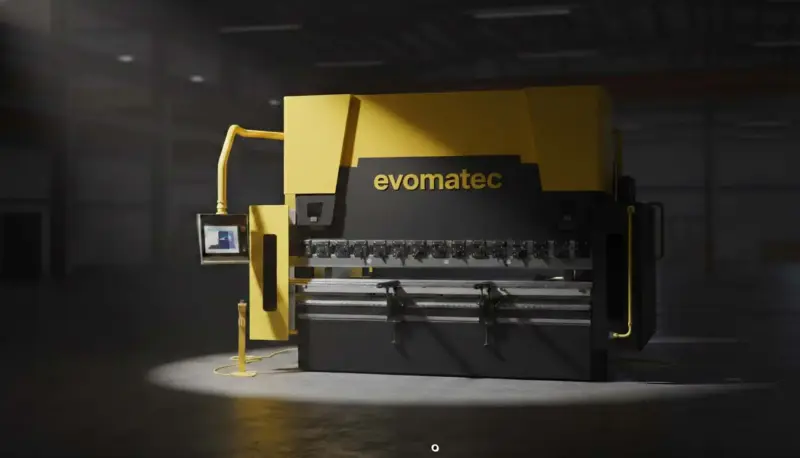
Press Brake Machine Hybrid Press Brake for Precise Sheet Metal Bending with Low Energy Costs EVO III
Why the Press Brake Has Become the Core of Modern Sheet Metal Fabrication
In industrial manufacturing, quality is often decided at edges, radii, and angles. Where extensive manual straightening, rework, and control measuring used to be necessary, modern systems now deliver reproducible results at true production quality. This is exactly where the press brake stands as a central machine: it combines precision, productivity, and profitability in a process that integrates perfectly into modern sheet metal fabrication.
A modern press brake is no longer just a heavy press with tools. It is a highly precise system made up of control technology, axis regulation, measuring and correction mechanics, tooling technology, material know-how, and process expertise. Anyone who wants to bend sheet metal or form metal efficiently needs a clean, predictable process: from cutting through the bending sequence to final inspection. In many shops, press brake forming is the bottleneck, but also the greatest lever: with the right machine, output, repeat accuracy, and surface quality increase, while scrap, rework, and downtime decrease.
This development becomes especially clear when looking at modern concepts such as hybrid drives, closed hydraulic systems, servo-driven axes, and intelligent crowning. It is precisely in this environment that the EVO III positions itself as a hybrid solution for companies that want to consistently combine high precision, low operating costs, and sustainable manufacturing.
Product Information EVO III Hybrid Press Brake
The EVO III Hybrid Press Brake is an energy-efficient, high-precision bending solution for demanding applications in industrial sheet metal production. Developed on the basis of decades of press brake experience, it combines modern hybrid technology with a closed hydraulic system and achieves energy savings of up to 73 percent compared to conventional systems. The closed hydraulic circuit reduces maintenance effort, and with only 34.5 liters of oil, the machine is designed to be particularly environmentally conscious.
With 4.1 meters bending length and up to 260 tons of press force, the EVO III covers a wide range, from medium-sized components to large-format sheet metal parts. The 6-axis CNC control is integrated as standard, as is motorized crowning for precise angles across the entire bending length. High axis dynamics minimize non-productive time: a 200 millimeters per second approach speed accelerates cycle time, while a 10 millimeters per second working speed supports controlled, clean bends. With a noise level of only 63 decibels, the system creates a significantly more comfortable working environment than many conventional machines.
Additional features such as a servo-driven backgauge, a large throat depth of 410 millimeters, a high ram stroke of 275 millimeters, and a daylight opening of 550 millimeters provide flexibility for complex workpieces, deep boxes, and repeatable series production. Realistic 3D programming support via ER TOUCH simplifies programming and operation, reduces setup time, and prevents collision errors.
Technical Data EVO III at a Glance
| Parameter | EVO III Hybrid Press Brake |
|---|---|
| Technology Set (for configuration) | SET 50/ 500-5.5 P |
| Bending length | 4,100 mm (options 2,100 to 6,100 mm) |
| Press force | up to 260 t (options 100 to 260 t) |
| Ram stroke | 275 mm |
| Daylight opening | 550 mm |
| Throat depth (reach) | 410 mm |
| Axes | Standard 6 axes: Y1, Y2, X, R, Z1, Z2 |
| Approach speed | 200 mm/s |
| Working speed | 10 mm/s |
| Return speed | 190 mm/s |
| Hydraulic system | closed circuit, low maintenance |
| Oil volume | 34.5 l |
| Noise level | 63 dB |
| Crowning | motorized, standard |
| Backgauge | servo-driven, high-precision positioning |
| 3D support | realistic 3D programming and operator guidance via ER TOUCH |
Press Brake, CNC Press Brake, or Folding Machine: What Companies Really Search For
In practice, several terms are used, often depending on region, industry, or company size. Some speak of a folding machine, others of a sheet metal bending machine or, more generally, a bending machine. What matters, however, is not the name but the technical capability: axis accuracy, stability, press force reserve, tooling standard, control logic, and process reliability.
A basic folding machine can be sufficient for simple profiles. But when series production, frequent part changes, tight angle and dimensional tolerances, or sensitive surfaces are required, there is hardly any way around a CNC solution. This is exactly why search terms such as CNC press brake and CNC bending machine are in such high demand: companies look for predictable quality and repeatable production without relying on individual experts to adjust every bend by feel.
How a Press Brake Works: Die Bending as the Industrial Standard
Most modern systems operate as a die bending press. The sheet is positioned between the upper and lower tool and formed in a controlled way. The core principle is simple, but the reality is demanding: material thickness, strength, bending direction, grain flow, tool geometry, die opening, and springback influence the final angle.
To keep the process stable, several building blocks are required:
Stable press force and a rigid machine for consistent results
Precise backgauge for repeatable insertion depth
Suitable press brake tooling and correctly selected dies
A clean correction mechanism such as crowning for consistent angles
Process knowledge of material springback and angle strategy
In this environment, terms such as bending angle, bending length, press force, and press brake tonnage take on a very concrete meaning. They are not just data sheet values, but determine whether a part can be produced reliably or whether rework, scrap, and time losses occur.
Hybrid Technology in the Press Brake: Why Less Energy Often Means More Performance
Many companies face the same goal conflict: higher volumes and better quality while energy costs continue to rise. Conventional hydraulic systems deliver high forces, but consume unnecessary energy in many operating states. Modern hybrid concepts address exactly this: energy is provided on demand, non-productive times are reduced, and the overall efficiency of the system increases.
The EVO III uses a hybrid concept and achieves energy savings of up to 73 percent compared to conventional systems. This directly improves profitability, especially in multi-shift operation or with a high series-production share. At the same time, the thermal load decreases, which reduces oil stress and improves process stability.
The second point is maintenance: a closed system reduces contamination, lowers oil volume, and minimizes typical maintenance points. The combination of a closed circuit and only 34.5 liters of oil is not only an environmental argument, but also a practical advantage: oil changes, leakage risk, and downtime are reduced.
Hydraulic Press Brake, Electric Press Brake, Servo-Electric Press Brake: Which Technology Fits When
When selecting a machine, companies often hear three main categories:
hydraulic press brake
electric press brake
servo-electric press brake
Hydraulics traditionally stand for high forces and robust industrial design. Electric concepts score with efficiency, cleanliness, and dynamics, but depending on size and force class, they are not always the first choice. Servo-electric systems combine the advantages of controllability and efficiency, but require a suitable machine architecture.
Hybrid solutions are often the best compromise in practice: high press force reserves, stable bending capability over long lengths, and at the same time a significantly reduced energy demand. This is exactly why hybrid machines are attractive in many production environments: steel construction, enclosure manufacturing, mechanical engineering, sheet metal furniture, control cabinet building, and general metal fabrication.
Precision in the Sheet Metal Bending Machine: Backgauge, Axes, and Repeatability
Anyone producing with precision thinks in axes, not only in tons. A modern CNC machine works at minimum with the ram axes and a backgauge axis. In practice, 6 axes are a very common standard today for demanding parts, because they enable complex bending sequences and stabilize positioning.
On the EVO III, a 6-axis system is integrated as standard: Y1, Y2, X, R, Z1, Z2. This means:
Y1 and Y2 control the ram on the left and right separately and ensure parallelism
X positions the backgauge in the longitudinal direction
R controls the backgauge height, important for different bending stages
Z1 and Z2 enable segmented stops or flexible positioning for asymmetric parts
A servo-driven backgauge additionally ensures that positions are reached quickly and held securely. This reduces non-productive time and increases process capability. In search queries, this area often appears under terms such as backgauge, bending aid, or also under tooling topics, because loading, gauging, and bending belong together in real production.
Crowning: The Key to Uniform Angles Across the Entire Bending Length
With long bending lengths, the frame can deflect slightly depending on force and load distribution. Without correction, this causes angles in the center to differ from those on the sides. That is exactly why crowning is so important. Under the search term crowning, fabricators understand a correction system that compensates for this deflection.
The EVO III offers motorized crowning as standard. This is especially relevant for series production, because settings can be stored reproducibly. Anyone who frequently switches between materials and thicknesses benefits as well: the operator can adjust crowning to the job and obtains consistent angles across the full length.
Press Brake Tooling, Upper Tool, Lower Tool: Why Tooling Makes the Difference
When buying a machine, many people first look at tonnage and length. In production, however, the tool determines the result and process stability. Search terms such as press brake tool, press brake tools, upper tool press brake, and lower tool press brake are therefore so common because companies want to solve real problems: prevent tool marks, bend tight radii, realize short flanges, reduce collisions, and shorten setup times.
In principle:
The upper tool is the punch, and its geometry determines radius and edge formation
The lower tool is the die, and its opening influences force requirement, radius, and springback
Segmented tools increase flexibility, reduce setup time, and simplify series changeovers
Tool standards and compatibility protect investments and ensure fast procurement
In practice, many searches focus on press brake die and press brake punch, because these parts wear in daily operation or must be adapted to new products. A professional sheet metal production therefore calculates not only the machine, but the entire system of tooling, operating workflow, and quality strategy.
Bending Angle, Springback, and Material Behavior: The Underestimated Part of the Process
Anyone who wants to bend steel, stainless steel, or aluminum reliably must understand material springback. The higher the strength, the stronger the springback, and the more important stable control and a defined angle strategy become. Stainless steel often requires higher forces and is more sensitive to surface marks. Aluminum is softer, but reacts sensitively to tool surfaces and can show pressure marks with the wrong die selection.
The most important factors influencing the angle are:
Material thickness and actual thickness tolerances
Strength, condition, and batch variations
Die opening and tool radius
Bending speed and process window
Crowning and ram parallelism
Part length and force distribution
Anyone who stabilizes these factors achieves reproducible bending angles and reduces measuring and correction effort. This is exactly where modern controls, axis regulation, and clean mechanics help.
Angle Measurement System: When Real-Time Measuring Pays Off
Many companies search for an angle measurement system because they still see variation despite good machine mechanics: material batches, temperature, tool condition, or different operators. An angle measurement system measures the angle during or directly after bending and can automatically correct. Especially with high part variability or very tight angle tolerances, it is a productivity lever: fewer trial parts, less re-bending, less scrap.
Depending on the design, an angle measurement system is an option that often pays for itself quickly when materials and thicknesses change frequently or when quality requirements are especially high.
High Speed, Low Non-Productive Time: Why Approach and Return Matter
For many parts, it is not the pure bending time that drives costs, but the total of loading, gauging, approach, bending, return, and unloading. The EVO III provides clear values here: 200 millimeters per second approach, 10 millimeters per second working speed, 190 millimeters per second return. This means: fast non-productive time, but controlled bending in the working window so that surface and angle remain stable.
In practice, this mix often leads to a noticeable gain because the machine produces more parts per shift without the quality rate dropping.
Quiet Operation and Ergonomic Manufacturing: Productivity Starts with the Operator
At 63 decibels, the machine operates in a range that is perceived as significantly more comfortable in many production halls than conventional systems. A quieter process means less stress, less fatigue, and often fewer communication issues between the team and the operator. Especially in multi-shift environments, this can be an underestimated factor: a better workplace stabilizes quality and reduces mistakes.
Laser Cutting and Press Brake Bending: The Standard Process in Modern Sheet Metal Production
Many companies specifically search for laser cutting and press brake bending because this combination is considered standard today. The laser delivers fast, precise blanks, and the press brake creates the final form. For this workflow to run efficiently, both processes must be coordinated:
clean cut edges for stable reference edges during gauging
correct flat pattern, so dimensions are right after bending
defined bending sequence to prevent collisions
tool selection matched to the geometry
repeatable gauging process via backgauge and gauging fingers
This is where 3D support becomes important: a realistic simulation shows sequence, tool selection, and possible collisions before the first part is bent. This reduces the risk of costly errors, especially with large parts or complex boxes.
3D Support and Operating Logic: Less Setup Time, Fewer Errors
The EVO III offers realistic 3D support via ER TOUCH. The benefit is practical: operators can distinguish parts, understand bending sequences, and identify potential collisions early. This accelerates training for new employees, reduces setup time, and stabilizes quality. Especially with a high variety of parts, it is a decisive lever: fewer trial parts, less adjustment, faster job changeovers.
Buying a Press Brake: Selection Criteria That Matter in Practice
Anyone searching for buy a press brake often thinks first of press force and length. For a truly suitable investment, companies should proceed systematically:
Analyze the part portfolio: material, thickness, length, geometry, tolerances
Calculate press force realistically, with reserve for high strengths
Choose bending length appropriately: not too tight, but not oversized
Clarify axis requirements: simple parts, or complex boxes and steps
Define tooling standard: segmentation, quick clamping, compatibility
Plan crowning as a must, especially for long bending lengths
Evaluate control and programming: operator friendliness, 3D functions
Service and spare parts supply: response times, training, documentation
Calculate energy and operating costs: not only purchase, but life cycle
That is why search terms such as press brake manufacturer are so common: many buyers want not only a machine, but a long-term partnership in service, tooling advice, and process support.
Press Brake Price and Profitability: Why Operating Costs Matter More Than the Purchase Amount
The press brake price is a key topic, but a serious evaluation considers the entire life cycle. Anyone who compares only the purchase price often overlooks the main costs:
Energy consumption over multiple years
Maintenance, oil changes, wear parts
Downtime due to unplanned failures
Scrap and rework from unstable processes
Setup time and operator effort
Tooling investments and tool change times
Hybrid technology and a closed hydraulic circuit have exactly this effect: less energy, less oil, less maintenance. At the same time, a precise backgauge, axis stability, and motorized crowning reduce rework. The result is usually a much better overall calculation, especially with high utilization.
Used Press Brake: When Used Makes Sense and When It Does Not
Many companies search for a used press brake because the entry price seems lower. Used can make sense if:
the part portfolio is stable and simple
sufficient tooling is available
service and spare parts are secured
axis accuracy and frame condition have been verified
control and safety technology match the requirements
It becomes critical when high precision, changing parts, and short delivery times are required. Then a modern CNC solution with stable process control and low operating costs can be cheaper overall, even if the purchase price is higher. Here, it is worth evaluating energy, downtime, and scrap.
Metalworking and Sheet Metal Production: Typical Applications for the EVO III
In metalworking and sheet metal production, there are typical workpieces that a 4.1 meter machine with high press force covers particularly well:
long side panels and covers in mechanical engineering
control cabinet and enclosure components
profiles, brackets, holders, supports
boxes, trays, hoods, claddings
steel parts with high strengths and high force requirements
stainless steel parts with high surface requirements
aluminum parts with a focus on clean surfaces and reproducible angles
It is not only the force that matters, but also throat depth, daylight opening, and stroke. 410 millimeters throat depth and 550 millimeters daylight opening expand the spectrum significantly, because deeper parts can be produced without collisions.
Process Reliability in Daily Work: From the Loading Edge to Series Quality
A high-performance sheet metal bending machine is only as good as the process built around it. Companies that deliver consistently high quality standardize three things:
Material and blank quality
Tooling and setup standards
Inspection and correction strategy
In concrete terms, that means: same die openings for the same thicknesses, defined tool groups, clear bending sequences, clean gauging surfaces, regular tool inspection, and a documented first-article approval. With a stable machine and clean process organization, bending becomes a predictable production step, not an experience-based variable.
EVO III Hybrid Press Brake as a Sustainable Solution for Precision, Speed, and Low Operating Costs
The EVO III Hybrid Press Brake combines high press force and long bending length with modern energy efficiency and process-reliable precision. Up to 73 percent energy savings, a closed hydraulic circuit with only 34.5 liters of oil, 6 axes as standard, motorized crowning, a servo-driven backgauge, high speeds, and quiet operation at 63 decibels: this combination targets exactly what companies look for today when evaluating a bending solution for demanding series production and flexible jobs. Anyone who wants to consistently bring quality, productivity, and profitability together in sheet metal fabrication will find a strong foundation for sustainable competitiveness in this design.